New Jersey is not what you think it is. Beneath the boardwalks and beach towns, beyond the Turnpike exits and the noise, something older waits. Look closer and the state reveals itself in shadows: Victorian seaside hotels draped in sea mist, lonely lighthouses standing watch over dark waters, colonial mansions that hold their secrets close, abandoned prisons where silence has a weight to it, and deep pine forests where the folklore closes in around you.
This is a road trip through that other New Jersey.
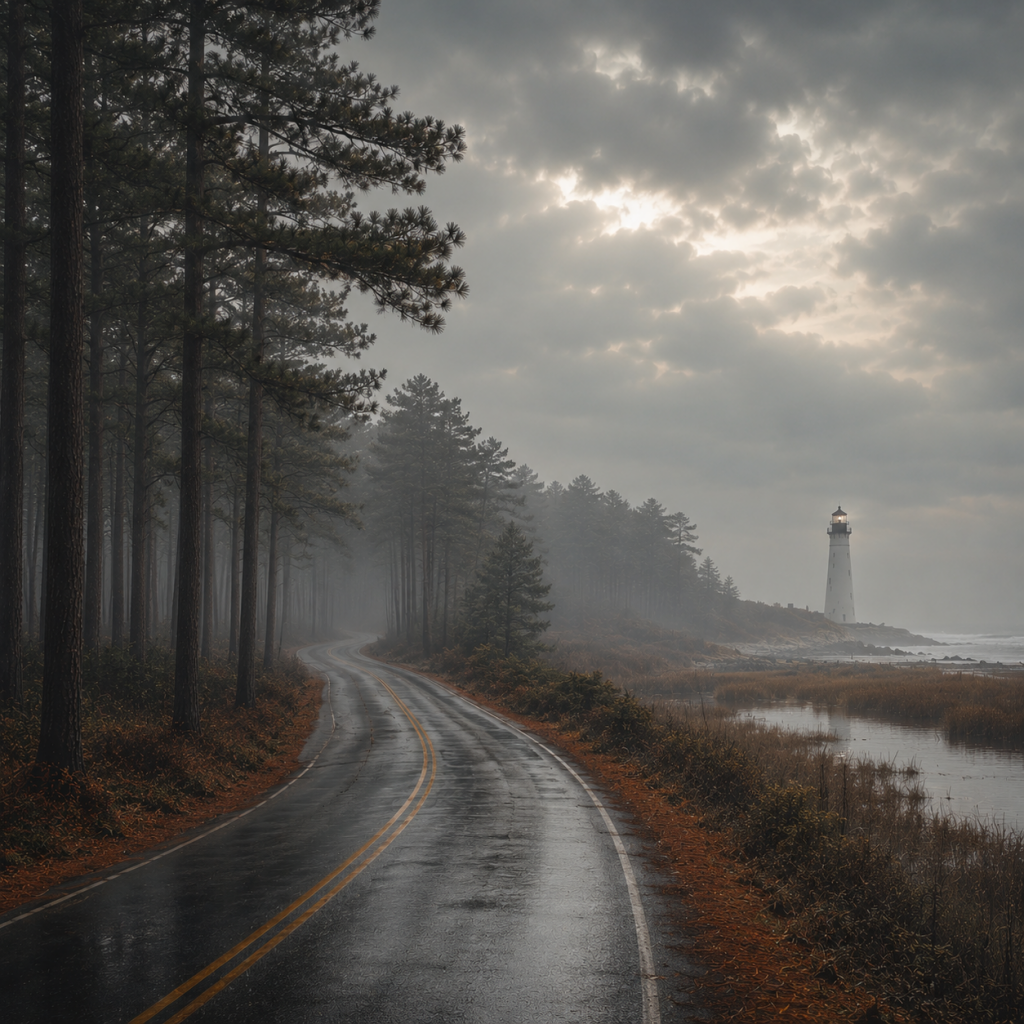
It begins on the southern coast in Cape May, where ghost stories have been drifting through the corridors of old hotels for more than a century. From there, the route moves north through Atlantic City’s faded grandeur, turns inland toward the Pine Barrens, and continues through haunted villages, true crime landmarks, old taverns, and the darker myths of North Jersey. Along the way, you’ll trace the edge of the Jersey Devil’s territory, step into historic homes that still feel occupied by memory, and end near one of the most infamous haunted roads in the state.
Part haunted getaway, part folklore trail, part true crime journey. Plan it right, and you’ll find that New Jersey makes for one of the most quietly unsettling weekend escapes in the entire Northeast.
👻 Win an Eerie Escapes Box
Enter the monthly giveaway for a chance to win a curated box of travel-inspired and spooky finds.
🔦👻 Download the Free Haunted America Explorer Bundle!
Six free printable downloads, including a haunted America map, locations guide, checklist, and more to help you explore America’s eeriest places.
How to Use This New Jersey Spooky Road Trip
This itinerary is designed as a weekend road trip, beginning Friday night in Cape May and ending Sunday evening near Clinton Road in North Jersey. Saturday and Sunday are full days, with haunted hotels, lighthouses, Pine Barrens folklore, true crime history, historic homes, and one final infamous road. If you have extra time, add the optional Monday stops to slow the pace, catch anything you missed, or make one last eerie detour before heading home.
The route is not meant to be a race to every stop. The Pine Barrens section especially works best when you choose a few meaningful places instead of trying to check off everything. The real mood of this trip comes from the shift: bright seaside Cape May, Atlantic City’s old lighthouse, the quiet forest roads of the Pines, Flemington’s true crime history, and finally the legends of North Jersey.
Your Spooky New Jersey Road Trip Itinerary
Friday Night: Start in Haunted Cape May
Begin your trip in Cape May, one of the most haunted small towns in America, where Victorian beauty, seaside elegance, and more than a century of ghost stories gather just beyond the beach. With its oceanfront hotels, preserved mansions, gaslamp-style streets, and long resort history, Cape May already feels like it was built for ghost stories.
Check into Hotel Macomber or Congress Hall if you want to begin with a haunted hotel stay. Hotel Macomber brings a more intimate haunted-seaside feeling to Cape May, with its shingled exterior, oceanfront setting, and old resort-hotel charm. Built in the early 20th century, the hotel is known for ghost stories surrounding Room 10, where the spirit called the Trunk Lady is said to linger. According to legend, she was Irene Wright, a frequent summer guest who returned year after year after the death of her husband, always bringing a heavy steamer trunk with her. Guests and staff have reported hearing the trunk dragged down the hall, loud knocking on doors, and whispers near Room 10, as if Irene is still arriving for another Cape May season.
Congress Hall is grander, brighter, and more iconic, but no less atmospheric. Originally opened in 1816, the sprawling yellow hotel has hosted presidents, summer crowds, and generations of guests who came to Cape May for saltwater glamour. Its ghost stories often center on old hotel presences: children reportedly heard playing in empty corridors, a woman in period clothing, and lingering figures said to appear near guest rooms and public spaces. Unlike Cape May’s smaller haunted inns, Congress Hall feels haunted on a larger scale, as if the whole building remembers every season that passed through it.
If you are not staying overnight at Congress Hall, stop in for dinner or drinks at The Blue Pig Tavern, The Brown Room, or the Veranda Bar. It is a great way to get the old Cape May resort atmosphere without needing to book a room.
After dinner, take a Cape May ghost walking tour to get acquainted with the town’s haunted Victorian streets, seaside hotels, and historic homes.
Saturday Morning: Lighthouses, Mansions, and the Shoreline
Start Saturday at Cape May Lighthouse in Cape May Point. Built in 1859, the lighthouse rises where the Atlantic Ocean, Delaware Bay, and windswept marshland meet, giving the whole point a lonely, watchful mood. Local ghost stories often speak of former keepers, phantom lights, and shadowy figures near the tower. Even on a bright day, the climb and the surrounding dunes carry the feeling of a place built to stand guard against disaster.
This is also one of the best photo stops of the trip. Capture the lighthouse rising over the dunes, or frame it from one of the nearby trails with the marshland in view.
From there, head to the Emlen Physick Estate, Cape May’s great Victorian haunted house. Built in 1879 for Dr. Emlen Physick, his widowed mother, and his maiden aunts, the Stick-style mansion has sharply peaked rooflines, shadowed porches, and preserved period rooms that make it feel like the architectural embodiment of a ghost story. Its haunted reputation often centers on the Physick family itself, with stories of unexplained movement, lingering presences, and the possible spirit of Aunt Emilie, who is said to remain attached to the home. Visitors have also described the feeling of being watched in the upper rooms, as if the old household has never fully vacated.
Scare challenge: Before your tour, take a photo of the estate from the lawn. Take another after you leave. Later, compare the upper windows, porch shadows, and reflections, especially if you visited close to dusk.
After Cape May, drive north toward Atlantic City for Absecon Lighthouse, New Jersey’s tallest lighthouse. First lit in 1857, the black-and-yellow tower still rises over the shore with its long spiral climb. It was built after the 1854 wreck of the Powhatan, a passenger ship caught in a brutal winter nor’easter that killed more than 300 people and helped give the nearby waters their grim “Graveyard Inlet” reputation. The lighthouse’s haunted stories include the laughter of a young girl heard near the tower, unseen footsteps and heavy breathing on the stairs, and doors opening and closing on their own.
Saturday Afternoon: Into the Pine Barrens
From Atlantic City, turn inland. This is where the road trip changes character.
The Pine Barrens stretch across more than a million acres of South Jersey, a vast, sandy, pitch-pine wilderness threaded with old roads, cedar swamps, abandoned industries, ghost towns, and folklore. This is the home ground of the Jersey Devil, but the region’s eerie reputation goes far beyond one creature. Generations of stories have attached themselves to the Pines: phantom dogs, lost travelers, ruined villages, buried treasure, strange lights, lonely cemeteries, blue holes, hidden ruins, and roads that seem to slip deeper into the woods than they should.
No New Jersey legend looms larger than the Jersey Devil, the winged creature said to haunt the deep woods of the Pine Barrens. The most famous version begins in the 1700s, when Mother Leeds supposedly cursed her thirteenth child, only for the baby to transform into a horse-headed, hoofed, bat-winged creature and fly screaming into the pines. The legend exploded in 1909, when reported sightings, strange tracks, livestock attacks, and public panic spread across New Jersey and Pennsylvania.
But even without the Jersey Devil, the Pine Barrens feel built for folklore. The vast forest is scattered with vanished industries, old roads, abandoned foundations, sandy tracks, and stories of wrong turns where familiar routes suddenly feel impossible to navigate. The result is not one haunted house or one ghost story, but an entire landscape that feels half-real and half-legend.
For this part of the day, choose two to four of the following Pine Barrens stops depending on your energy and timing.
Batsto Village is one of the best tangible Pine Barrens stops. Unlike some folklore sites that exist mostly as road names or local legends, Batsto gives you preserved buildings, quiet paths, water views, and the feeling of a village held in time. It is one of the best places to photograph the Pine Barrens’ ghost-town mood.
Carranza Memorial is deeper and lonelier. The monument marks the 1928 crash site of Captain Emilio Carranza, a Mexican aviation hero who died while attempting a goodwill flight between Mexico and the United States. The memorial stands far down quiet forest roads, and the drive itself has become part of the lore, with visitors describing eerie stillness, strange lights, and the feeling of being watched among the pines.
Scare challenge: At Carranza Memorial, use your phone’s voice memo app to record one minute of silence near the monument. Ask one respectful question, then listen back later for anything hidden beneath the wind and pine trees.
Ong’s Hat is less of an attraction and more of a folklore stop. Once a tiny Pine Barrens settlement, it later became attached to stories of secret experiments, underground researchers, and interdimensional travel. The legend spread through zines, mail art, bulletin boards, and early internet culture, often described as one of the first alternate reality games. Today, treat Ong’s Hat as a drive-through legend rather than a preserved ghost town.
Wharton State Forest is where you can actually step into the pines. Choose a short, marked trail or scenic area and keep the walk simple. This is not the place for wandering off-route or trying to chase legends down unmarked roads.
Before leaving South Jersey, you can also make a haunted-history detour to Burlington County Prison Museum in Mount Holly. It is not really a Pine Barrens stop, but it fits naturally into this part of the route if you want a more structured indoor site between the folklore-heavy forest roads and the drive north toward Flemington. Built in 1811 and used for more than 150 years, the old stone prison has narrow corridors, heavy cell doors, upper tiers, and a haunted reputation tied to Joel Clough, who was hanged there in 1833 for the murder of Mary Hamilton. He is said to have cursed the prison before his execution, and visitors and investigators have reported activity near the gallows and old cells. The building feels less like a museum than a place still waiting for someone to answer from behind the bars.
Saturday Evening: Flemington and the Lindbergh Trial
By evening, continue north toward Flemington. If possible, stay near the historic downtown area so you can connect the trip’s haunted mood with one of New Jersey’s most haunting true crime chapters.
The Union Hotel anchors Flemington’s Main Street with red brick, arched windows, and a story tied to one of the most notorious trials of the 20th century. In 1932, twenty-month-old Charles Lindbergh Jr. was taken from his family’s home near Hopewell, New Jersey, setting off one of the most famous criminal investigations in American history. The case unfolded through ransom notes, ladder evidence, a massive search, and, eventually, the 1935 trial of Bruno Richard Hauptmann in Flemington.
During the trial, the Hunterdon County Courthouse sat directly across from the Union Hotel, and the hotel became part of the national media spectacle, filled with reporters, trial-watchers, and figures connected to the case. That alone would give the building a heavy true-crime atmosphere, but the Union Hotel is also known as one of Flemington’s most famously haunted landmarks. Stories from the old hotel include unseen presences, poltergeist-like activity, children heard or seen in empty rooms, and even reports of shoes moving up a staircase by themselves. Between its haunted reputation and its role in the Lindbergh trial frenzy, the Union Hotel feels like more than a historic building. It feels like a place where New Jersey’s ghost stories and crime history briefly shared the same lobby.
Sunday Morning: The Red Mill and Colonial Ghosts
Start Sunday at Red Mill Museum Village in Clinton. The red mill beside the South Branch of the Raritan River is one of New Jersey’s most photogenic historic sites, with its red-painted walls reflected in the dark water below. Built in the early 19th century and later used for milling, quarrying, and other industries, the site now operates as a museum village with preserved buildings, exhibits, and seasonal events.
Its haunted reputation centers on reports of an old man in period clothing and a black hat seen on the third floor, only for staff to explain that no such reenactor was present. Stories also mention child spirits near the mill and a long record of unexplained sightings that helped earn the Red Mill a place on paranormal television.
From Clinton, head east toward Proprietary House in Perth Amboy. Built in the 1760s, it is the last surviving royal governor’s mansion from the original Thirteen Colonies. Its most famous resident was William Franklin, Benjamin Franklin’s Loyalist son, who lived here before being arrested during the Revolutionary War. Ghost stories include a mysterious woman in white, apparitions in colonial clothing, and unexplained activity in the old rooms. Some visitors connect the lingering presences to the house’s Revolutionary-era tensions, when family loyalty, political betrayal, and the future of the colonies all pressed against its walls.
Stop for lunch at The Old Canal Inn in Nutley, one of New Jersey’s classic haunted taverns. It is known for its eerie “Death Seat” legend and stories of spirits lingering near the bar, which makes it a fitting break between historic mansions and haunted roads.
Sunday Afternoon: Mansions, Towers, and North Jersey Legends
Sunday afternoon is flexible. Choose two or three stops depending on how much driving you want to do.
Dey Mansion in Wayne was built around 1770 and served as George Washington’s headquarters several times during the Revolutionary War. Its haunted reputation tends to gather around residual Revolutionary-era energy: soldiers moving through the house, unseen footsteps on old floors, and presences tied to the many families who lived and died on the property. Compared with New Jersey’s louder roadside legends, Dey Mansion offers a quieter kind of unease, the feeling of a historic home still occupied by memory.
Devil’s Tower in Alpine is a gothic stone tower connected to one of North Jersey’s most famous local legends. Built by sugar magnate Manuel Rionda in the early 1900s, the tower was allegedly constructed so his wife, Harriet, could look out toward New York City. In the darker version of the story, she saw him with another woman, climbed the tower, and leapt to her death, though the historical details are disputed. The legend says her spirit still lingers there, and that anyone who circles the tower backward or drives around it a certain number of times may see her apparition in the upper window. Visit this one as a respectful drive-by only. View it from the public roadway and do not trespass.
Ringwood Manor sits within Ringwood State Park, surrounded by iron-mining history, old family wealth, and the wooded edge of the Ramapo Mountains. Its ghost lore is unusually specific, with stories of Jackson White, a servant said to haunt a second-floor bedroom where he was allegedly beaten to death. Reports include crying, footsteps, rumpled sheets, and the thud of something heavy falling in the empty room. Other legends point to Robert Erskine, Revolutionary War mapmaker and ironmaster, whose spirit is sometimes said to appear near his grave overlooking the pond. With its historic rooms, graveyard, and forested grounds, Ringwood Manor feels like a northern New Jersey estate that never entirely emptied.
Sunday Evening: End on Clinton Road
End the weekend with Clinton Road in West Milford, one of New Jersey’s most infamous haunted roads.
This lonely stretch through the woods is layered with ghost stories, urban legends, and a real crime connection. Its best-known spirit is the Ghost Boy of Dead Man’s Curve, said to return coins tossed into the water below one of the bridges over Clinton Brook. Other stories tell of phantom headlights, a ghostly Camaro driven by a young woman killed in a crash, strange creatures in the woods, and unsettling encounters along the dark, winding road.
The road’s darker reputation deepened in 1983, when the body of Daniel Deppner was found nearby in a murder later tied to Richard “the Iceman” Kuklinski. That mix of folklore and actual crime history makes Clinton Road one of the strongest final stops on the route.
Drive the road carefully at dusk or after dark for the full effect. Only stop where it is safe and legal to pull over.
Scare challenge: If you cross one of the small bridges, remember the legend of the Ghost Boy. Some visitors toss a coin into the water below, hoping it will be returned. Whether you try it or not, leave the road exactly as you found it.
Optional Monday: Add One More Eerie Detour
Use Monday as a flexible catch-up day. If Saturday or Sunday ran long, return to any major stops you missed, especially Burlington County Prison Museum, Batsto Village, Ringwood Manor, Dey Mansion, or Proprietary House. This is also a good day to slow the pace, revisit the shore, or choose one final eerie detour before heading home.
The Watcher House in Westfield is one of New Jersey’s most infamous modern true crime locations. In 2014, a family purchased the home at 657 Boulevard and soon began receiving disturbing anonymous letters from someone calling themselves “The Watcher.” Because this is a private residence in a residential neighborhood, treat it only as a true-crime context stop. Drive by only if you can do so respectfully, without stopping, lingering, photographing residents, or disturbing the neighborhood.
Steuben House in River Edge offers another Revolutionary War-era stop with old-house atmosphere and a quieter pace. The historic home sits near the Hackensack River and works well if you want one more colonial history detour without adding another intense haunted-road experience.
Metlar-Bodine House in Piscataway is another historic house museum with local history, colonial atmosphere, and possible haunted-house appeal. It is a good add-on if you want a slower, more traditional museum stop before heading home.
Union County Courthouse in Elizabeth can work as a brief civic-history stop connected to New Jersey’s older legal and crime stories. This is more of a walk-by or drive-by than a major destination, but it can add another layer of courthouse atmosphere to a trip already shaped by trials, legends, and old crimes.
Guggenheim Memorial Library in Cape May is a quieter option if you are still near the shore or circling back south. The historic library offers a softer, more atmospheric local-history detour after the hotels, lighthouses, and ghost stories of the weekend.
Read or Watch Before You Go
To set the mood before this haunted New Jersey road trip, queue up The Watcher (2022, Netflix), especially if you plan to include the Westfield true crime detour, or watch The Lindbergh Kidnapping Case (1976) to better understand the media frenzy that once surrounded Flemington. If you want something more folklore-forward, The Jersey Devil: Monster in the Pines (2020) makes a fitting pre-trip watch before heading into the Pine Barrens.
For the road, pack The Pine Barrens by John McPhee, a classic portrait of the landscape, people, and mythology that shaped South Jersey’s most legendary wilderness. For a broader sense of the state’s hidden corners, bring Forgotten New Jersey: The Garden State’s Unique, Historic, and Abandoned Curiosities by Rich Ramano, which pairs well with a route built around old prisons, vanished settlements, haunted hotels, and historic homes.
By the time you leave Clinton Road behind, New Jersey may feel less like the state you thought you knew and more like a place where every shoreline, forest road, courthouse, and old hotel has a story waiting just out of sight. From Cape May’s haunted seaside elegance to the Pine Barrens’ deep folklore and North Jersey’s darker roadside legends, this route reveals a shadowed version of the Garden State, one best explored slowly, respectfully, and with an eye on the rearview mirror.
🕯️ Love exploring the eerie? Join the Eerie Dispatches newsletter for atmospheric, cozy-creepy, immersive stories about horror and true crime topics. We’re drawn to the mysterious, the unexplained, and the darkly fascinating. Come explore with us.