From haunted hotels and shadowy forests to infamous crime scenes and historic streets with centuries of strange stories, America is filled with wonderfully eerie places worth traveling for. My upcoming book, Eerie Escapes: 50 Scary Weekends in America, brings them together in 50 carefully curated, delightfully creepy weekend trips, including 30 regional trips and 20 seasonal escapes.
Inspired by the book’s regional trips, this Micro Eerie Escapes series gathers a few of the best experiences from my full weekend trips and compacts them into one-day spooky travel adventures, each built around a single day of eerie exploring and an overnight stay. Each escape combines haunted places, true crime, local legends, creepy accommodations, atmospheric meals, and thoughtful little details that carry the eerie mood from check-in to the final stop.
From Mothman to Flinderation Tunnel: A Paranormal West Virginia Escape
West Virginia’s narrow roads wind between wooded mountains, river towns, and hollows where even a short drive can feel like a journey into somewhere remote. Over one evening and one very full day, this escape follows some of the state’s strangest stories from the red-eyed creature that made Point Pleasant famous to an enormous former asylum, a museum devoted to creatures reported in the Appalachian forests, a haunted Victorian mansion, and an abandoned railroad tunnel where darkness waits at both ends.
The Itinerary
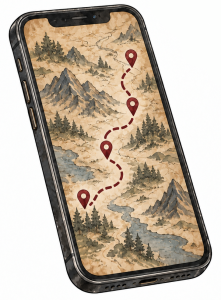
Preview: Mothman Museum • Lowe Hotel • Blennerhassett Hotel • Trans-Allegheny Lunatic Asylum • West Virginia Bigfoot Museum • Haunted Haymond • Flinderation Tunnel
Begin at the Mothman Museum
400 Main St, Point Pleasant, WV
Point Pleasant is a small town on the western edge of West Virginia, where the Kanawha River meets the Ohio River along the state line. Its compact downtown sits only a few blocks from the waterfront, but nearly everything here seems to lead back to one strange chapter in the town’s history. Mothman appears on murals, signs, storefronts, souvenirs, and a gleaming metal statue standing in the center of town.
The story began on a cold November night in 1966, when two young couples driving near an abandoned World War II explosives plant outside Point Pleasant encountered something they could not explain. They described a towering humanlike figure with wings folded against its back and enormous red eyes that reflected their headlights. According to their account, the creature rose into the air and followed their car as they sped back toward town.
The sighting was only the beginning. Over the following months, other residents reported red eyes, winged figures, unexplained lights, strange telephone calls, and unsettling activity around the wooded roads and concrete storage bunkers of the former West Virginia Ordnance Works, known locally as the TNT Area.
Then, on December 15, 1967, the Silver Bridge connecting Point Pleasant with Ohio collapsed during evening traffic, sending vehicles into the river and killing 46 people. Investigators ultimately traced the disaster to the failure of a critical bridge component, but the timing permanently changed the Mothman story. The creature became associated with the tragedy, and some came to believe it had appeared as an omen or warning of the disaster to come.
Nearly sixty years later, Mothman is still going strong. The legend has inspired books, including John Keel’s The Mothman Prophecies, a 2002 Hollywood film, documentaries, podcasts, and an annual festival, and it has made this small West Virginia river town famous around the world.
Arrive in Point Pleasant by 5:00 p.m. and visit the Mothman Museum, the world’s only museum devoted entirely to the legend. Newspaper clippings, eyewitness accounts, photographs, original documents, artwork, movie props, and memorabilia trace the story from the first sightings through the Silver Bridge collapse and Mothman’s continuing place in popular culture.
Visit the Mothman Statue and Try a Mothman-Themed Treat
Just outside the museum stands Point Pleasant’s larger-than-life tribute to its most famous resident. Created by West Virginia artist Bob Roach and unveiled in 2003, the polished metal Mothman statue towers over Gunn Park with enormous red eyes, a muscular body, and wings spread wide behind it. Take a few photographs with the statue, then look for Mothman murals, signs, and other red-eyed details around downtown.
Point Pleasant is known for Mothman-themed pizza, coffee, ice cream, and sweets. Check the downtown restaurants and shops for current options, which may include the signature Mothman Pizza at Village Pizza Inn or the Mothman Bowl at What’s the Scoop, a waffle bowl filled with three scoops of ice cream, whipped cream, cherry eyes, and chocolate-bar wings.
Spend the Night at the Lowe Hotel
401 Main St, Point Pleasant, WV
After dinner, check into the historic Lowe Hotel, often named among the most haunted hotels in West Virginia. Located directly across from the Mothman Museum, the hotel opened in the early twentieth century as the Spencer Hotel, welcoming river travelers, tradesmen, and steamboat crews with guest rooms, dining areas, a ballroom, and views toward the Ohio River.
Its most famous apparition is Juliette Smith, the unmarried daughter of one of the hotel’s early owners. She is said to appear barefoot on the mezzanine in a nightgown, dancing to music no one else can hear. Guests have also reported a child riding a squeaking tricycle along the second floor, a whistling maid, a riverboat captain waiting for a vessel that will never arrive, and a bearded man in old-fashioned clothing near Room 314. In the fourth-floor ballroom, some visitors have heard the faint music of a string quartet playing inside an otherwise empty room.
Request Room 314 if you want to stay near one of the hotel’s most frequently reported apparitions. After checking in, explore the mezzanine, staircases, and public rooms before returning to your room for a night surrounded by old woodwork, silent corridors, and the possibility of tricycle wheels passing outside the door.
At the time of writing, the Lowe Hotel is temporarily closed for an extensive restoration and is expected to reopen in 2027. Check its current status before planning the trip. If renovations are still underway, continue to Parkersburg and stay at the Blennerhassett Hotel instead.
Renovation Alternative: The Blennerhassett Hotel
320 Market St, Parkersburg, WV
The Blennerhassett Hotel is also frequently named among West Virginia’s most haunted hotels. Opened in 1889 during Parkersburg’s oil and gas boom, it retains the carved wood, fireplaces, chandeliers, and elaborate decoration of a prosperous late-nineteenth-century hotel.
Guests and staff have reported men in top hats, elegantly dressed women, and the sounds of children playing in the hallways. A mysterious woman is said to appear near the Fourth Street entrance, which once opened into the hotel’s gentlemen’s cigar room. Other stories involve unexplained music in the ballroom, a phantom newspaper boy in the kitchen, and loud knocking heard near the hotel’s coffee bar in the early morning.
Room 409 has developed an especially unsettling reputation. Accounts associated with the room include furniture moving without explanation, an apparition wearing a bowler hat, and one guest’s frightening claim that an unseen presence attempted to strangle her while she was in bed. As with the Lowe, these stories belong to the hotel’s accumulated folklore rather than documented history
The Next Morning: Enter the Trans-Allegheny Lunatic Asylum
71 Asylum Dr, Weston, WV
Leave Point Pleasant or Parkersburg early and travel into the mountains toward Weston, where the enormous stone facade of the Trans-Allegheny Lunatic Asylum stretches across the landscape like a fortress, a hulking reminder of the thousands of patients who once lived and died within its walls.
The hospital admitted its first patients in 1864. Designed according to the Kirkbride Plan, its long wings, tall windows, and spacious grounds were originally intended to provide a more humane environment for approximately 250 people. That vision did not last. By the middle of the twentieth century, the population had swelled to more than 2,000 patients. Wards became desperately overcrowded, privacy disappeared, and people suffering from mental illness, epilepsy, addiction, developmental disabilities, and other conditions were confined together inside a building that could no longer care for them properly.
The asylum closed in 1994, but its miles of corridors, peeling wards, treatment rooms, and rows of abandoned patient rooms remain. Even during a daytime tour, the building can feel unnervingly cut off from the world outside. Doors repeat one after another, dim hallways seem to narrow into darkness, and entire floors carry the oppressive silence of a place that once held far too many people.
Some visitors believe that silence is not complete. The asylum’s reported spirits include Lily, a young girl associated with the sound of a ball rolling across the floor, and a nurse said to continue making her rounds through the former wards. Guides, guests, and paranormal investigators have also reported shadow figures slipping across doorways, footsteps following tour groups, disembodied voices, sudden cold spots, and doors moving when no one is near them. With so many rooms and such a long, troubled history, Trans-Allegheny has earned a reputation as one of the most frightening paranormal destinations in the country.
Take the 90-minute tour covering all four floors of the main building and part of the Medical Center. As you move deeper into the asylum, pay attention to the empty doorways and the dark stretches of corridor behind the group. Historic tours generally operate first come, first served, so arrive in time for one of the earlier departures and confirm the current seasonal schedule before the trip. Allow approximately two hours for the tour, museum areas, grounds, and exterior photographs before continuing to Sutton.
Afternoon: Search for Bigfoot in Sutton
400 4th St, Sutton, WV
Few American legends are as thrilling as Bigfoot. Sightings have been reported in nearly every state, usually in the briefest and most frustrating of encounters: a towering figure crossing a remote road, an enormous shape moving between the trees, footprints that seem too large to be human, or a strange cry carrying through the darkness. The evidence is never quite enough, but the idea remains irresistible. Could an enormous, upright creature, part human in appearance and part wild primate, still be living deep within the country’s forests, intelligent enough to avoid us and glimpsed only when it strays too close to the modern world?
West Virginia seems made for such a mystery. Mountains fold over one another for miles, concealing dense forests, caves, abandoned mines, steep ravines, and isolated hollows rarely visited by anyone except hunters and hikers. Witnesses have described tall, hair-covered figures watching from tree lines, crossing rural roads in a few enormous strides, producing unidentifiable howls, and vanishing into the woods before anyone can obtain a clear photograph. Whether these encounters involve an undiscovered creature, mistaken wildlife, folklore, or something stranger, the landscape makes it easy to imagine that something could remain hidden there.
Continue to Sutton and visit the West Virginia Bigfoot Museum, where casts of enormous footprints, alleged hair samples, sighting maps, research materials, artwork, and eyewitness accounts examine reports from West Virginia and across Appalachia. The museum approaches Bigfoot with a mixture of curiosity and fun, but it also gives serious attention to the people who insist they encountered something in the forest that they could not explain.
Look closely at the footprint casts and regional sighting reports, then decide how much of the evidence you are willing to believe. Admission is free, and most visitors should allow approximately 30 to 45 minutes. Saturday hours are currently listed as 10:00 a.m. to 4:00 p.m., but verify the schedule before arriving.
Arrange a Visit to the Haunted Haymond
110 S Stonewall St, Sutton, WV
A short distance from the Bigfoot Museum stands the Haymond House, an elaborate Queen Anne home built in 1894 for prominent attorney William Edgar Haymond. A broad porch supported by round columns wraps the front of the wood-frame house, while steep gables, decorative trim, and an irregular roofline give it the ornate silhouette of a Victorian mansion. Inside, original woodwork and richly patterned wall coverings survive alongside the rooms, staircases, and shadowed upper hallways where unexplained activity is now reported. Its haunted reputation has grown strong enough to earn the house a place on the official West Virginia Paranormal Trail.
Haymond shared the house with his first wife, Emma, and later his second wife, Ethel. Both women reportedly died inside the home, and some believe one of them may be the woman in white now said to move silently between its rooms. Since purchasing the property in 2019, its current owners have reported footsteps pacing across the second floor when no one is upstairs, a tall gray figure watching from the shadows, and a smaller dark presence glimpsed near the staircase and upper rooms.
The basement has produced one of the house’s strangest accounts. During an investigation, witnesses reportedly saw a glowing orb approximately six inches across hovering in the darkness. Unlike the dust motes and tiny points of light commonly captured in photographs, this object was described as visible to the naked eye and large enough to watch as it moved through the room.
The Haymond House does not maintain the predictable walk-in schedule of a conventional museum. Contact the property well in advance to ask about a historical tour, paranormal investigation, special event, or other opportunity to enter the house. If no visit is available, view the exterior from the public street.
Near Dusk: Walk into Flinderation Tunnel
North Bend Rail Trail near Salem, WV
Finish the escape near Salem at Flinderation Tunnel, also known as Brandy Gap Tunnel No. 2. Its stone entrance opens from the woods like a black doorway into the hillside, leading into more than 1,000 feet of cold, dripping darkness. Even before sunset, daylight weakens rapidly inside, voices begin to echo from impossible directions, and the bright opening behind you grows smaller with every step.
Built in the 1850s as part of the Baltimore and Ohio Railroad, the tunnel once carried locomotives through the hills between Salem and Clarksburg. Shallow alcoves cut into its walls offered railroad workers a place to take cover when trains thundered through the narrow passage. According to local legend, at least one worker failed to reach an alcove in time and was struck and killed, while others reportedly died beneath falling rock. The historical details are difficult to confirm, but stories of railroad deaths have followed the tunnel for generations.
Visitors have reported screams, disembodied voices, shadowy figures, footsteps approaching through the darkness, and stones thrown by something they could not see. Some claim to have spotted the glow of a green railroad lantern moving through the tunnel without anyone carrying it. Others tell of a woman in white who appears near the entrance or walks ahead of visitors before vanishing into the blackness.
The tunnel may not be the only source of its voices. Brandy Gap Cemetery lies on the hill directly above it, with some graves reportedly dating to the eighteenth century. Local folklore suggests that sounds from the dead filter down through the earth and emerge inside the passage, where every whisper, scrape, and falling drop of water is distorted by stone.
Arrive while enough daylight remains to locate the trail and entrance safely. Bring dependable flashlights, wear sturdy shoes, download directions before losing reliable service, and never enter alone. Walk far enough for the woods outside to disappear and then switch off your lights for a few seconds. Listen for footsteps that do not belong to anyone in your group, a voice carried from deeper inside, or the distant rumble of a train on tracks that no longer exist.
Confirm current North Bend Rail Trail access and tunnel conditions before visiting, and obey all posted closures or restrictions.
Darker Stories: Local Crime and Legends
True Crime Story: The Quiet Dell Murders
In 1931, police investigating the disappearance of Massachusetts resident Dorothy Lemke followed a trail of letters to Quiet Dell, a small community near Clarksburg. There they uncovered the crimes of grocery-store owner Harry Powers, who had used false names, matrimonial advertisements, and matchmaking services to contact women seeking companionship. Posing as a wealthy civil engineer and promising marriage, he lured Lemke and Illinois widow Asta Eicher to West Virginia. Asta’s three children accompanied her. All five were murdered and buried on Powers’s property. Investigators also discovered trunks filled with letters from other women, raising questions about whether he had additional victims.
The discovery brought thousands of spectators to Quiet Dell, and Powers’s trial attracted such enormous crowds that it was moved into Clarksburg’s Moore Opera House. He was convicted of Lemke’s murder and executed at the West Virginia Penitentiary in 1932. The case later inspired West Virginia author Davis Grubb’s novel The Night of the Hunter and its acclaimed 1955 film adaptation, in which Robert Mitchum portrays a murderous preacher who charms a lonely widow while searching for hidden money.
Local Legend: The Flatwoods Monster
On September 12, 1952, several children playing outside in Flatwoods saw a brilliant object streak across the sky and appear to descend behind a nearby hill. Kathleen May accompanied them to investigate along with National Guardsman Eugene Lemon and the family dog. Near the hilltop, the group encountered a pulsing red light, a strange mist, and a towering figure with glowing eyes, a red face, a head or hood shaped like the ace of spades, and a dark metallic body resembling a long skirt. Witnesses said the creature appeared to float and hissed as it glided toward them, sending the group fleeing down the hillside.
Several witnesses later complained of nausea, throat irritation, and a lingering metallic odor. Investigators found no creature or spacecraft, and skeptics have proposed that the light was a meteor and the monster a barn owl distorted by foliage, darkness, and fear. Others remain convinced that the group encountered something connected to the object they saw fall from the sky. Now known as the Flatwoods Monster or Braxton County Monster, its unmistakable spade-shaped silhouette appears throughout the region, and the encounter is preserved at the Flatwoods Monster Museum in Sutton.
Complete the Escape
Pair It with a Ghost Story: “The Signal-Man”
Before entering Flinderation Tunnel, read “The Signal-Man” by Charles Dickens.
First published in 1866, the story follows a railway signalman stationed in a lonely cutting beside a dark tunnel. He is tormented by a spectral figure that appears near the tracks and cries out warnings before terrible accidents. Phantom bells, approaching trains, and the terrible uncertainty of whether disaster can be prevented make it an unnerving companion to an evening inside West Virginia’s most haunted railroad tunnel.
What to Watch Along the Route: The Mothman Prophecies
Return to Point Pleasant through the 2002 supernatural thriller The Mothman Prophecies, starring Richard Gere and Laura Linney.
Loosely inspired by John Keel’s book, the film follows a grieving journalist who inexplicably arrives in Point Pleasant and becomes entangled in reports of red eyes, impossible phone calls, prophetic warnings, and a presence that may know disaster is approaching. Its wintry roads, isolated houses, and gathering sense of doom capture the unease surrounding the Mothman legend without ever fully revealing what the creature might be.
Bring Home the Eerie: A Flatwoods Monster Lantern
While visiting Sutton, look for one of the ceramic Flatwoods Monster lanterns sold at the Flatwoods Monster Museum.
Originally created by the Braxton County Junior Chamber of Commerce in the late 1960s, the lanterns are still molded, fired, and painted locally. Shaped in the creature’s unmistakable spade-headed form, the lantern becomes especially eerie when illuminated from within, casting a glow through the same strange silhouette witnesses described on the hillside in 1952.
Until the Next Escape
I hope you’ve enjoyed coming along on this Micro Eerie Escape and feel inspired to take the trip yourself. Follow the entire itinerary or choose the stops that intrigue you most, then make the adventure your own. Until the next escape, may you find strange stories, atmospheric places, and just enough unease to follow you home.