
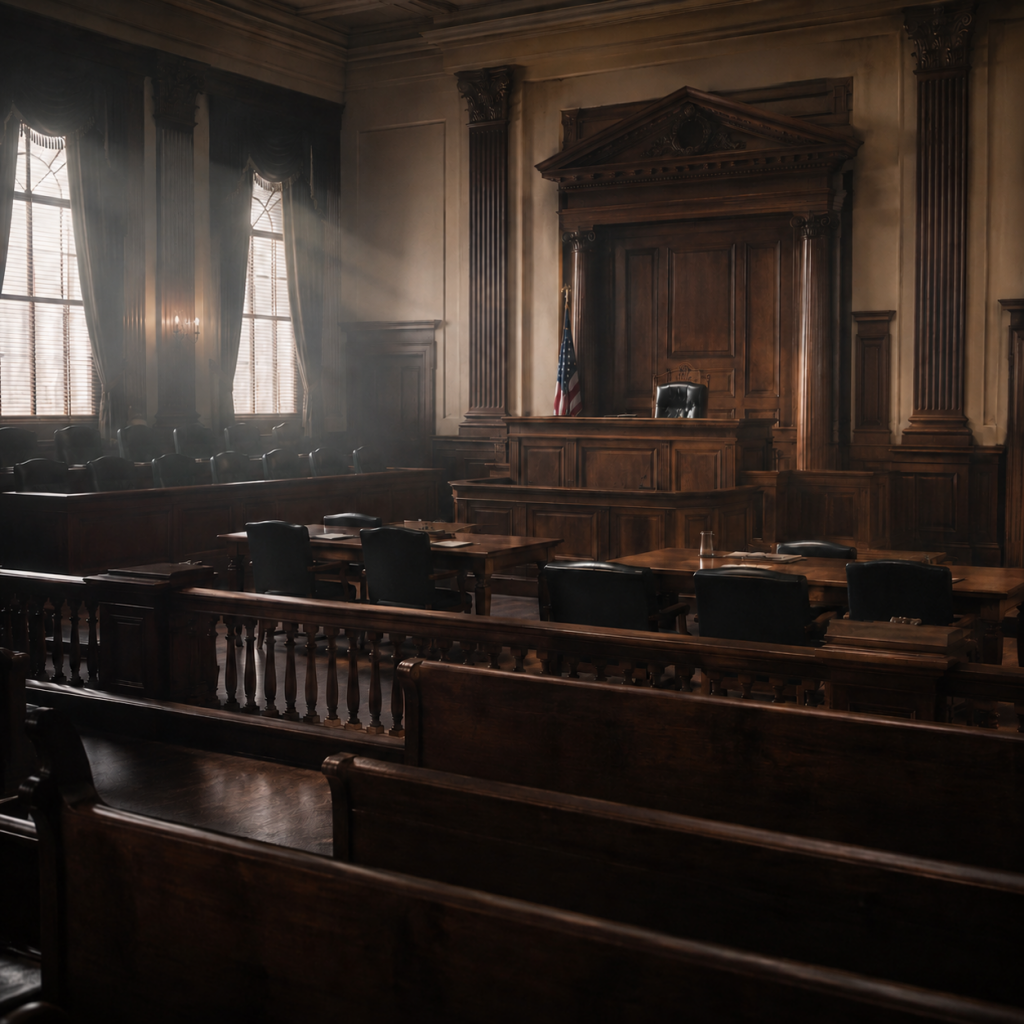
Some murder trials are remembered because of the crime itself. Others are remembered because the courtroom became something bigger: a stage, a battlefield, a spectacle, a national obsession.
These are the cases where Americans did not simply hear about a verdict after the fact. They followed along. They read every headline. They watched the news. They argued at kitchen tables and office desks. They formed opinions about guilt, innocence, justice, corruption, celebrity, gender, class, race, privilege, police power, and whether the legal system had gotten it right.
👻 Win an Eerie Escapes Box
Enter the monthly giveaway for a chance to win a curated box of travel-inspired and spooky finds.
The Newspaper Trials
Before Court TV, before livestreams, before TikTok detectives and Reddit threads, there were newspaper trials. These cases unfolded through screaming headlines, courtroom gossip, public rumors, and front-page reporting so dramatic it could turn a defendant into a household name.
Lizzie Borden, 1893
On August 4, 1892, Andrew and Abby Borden were found brutally murdered inside their Fall River, Massachusetts, home. Andrew had been attacked while resting on the sitting room sofa, and his wife, Abby, was found upstairs. The weapon was believed to be a hatchet or an axe, and suspicion soon turned toward Andrew’s younger daughter, Lizzie.
Lizzie was arrested and charged with the murders, but the case against her was never simple. The evidence was strange, incomplete, and full of gaps. There were questions about Lizzie’s behavior, possible motive, burned clothing, and long-simmering family tension. She had been at or near the house when the murders occurred, along with the family’s maid, Bridget Sullivan, and investigators struggled with the possibility that the killer had come from inside the Borden home.
By the time the case went to trial, Lizzie also had a formidable defense. Andrew Jennings, the Borden family attorney, was involved early and helped bring in George Robinson, a former governor of Massachusetts, to lead the defense. In June 1893, Lizzie Borden was acquitted. Legally, the case ended there. Culturally, it never did. More than a century later, people still argue over whether she was innocent, protected by gender and class assumptions, aided by excellent attorneys, or simply lucky enough to be tried in a world that could not yet picture a respectable Victorian woman wielding a murderous axe.
Harry Thaw / Stanford White, 1907–1908
Few early American trials had more scandal baked into them than the case of Harry Thaw, Stanford White, and Evelyn Nesbit.
Stanford White was a famous architect. Evelyn Nesbit was a beautiful young chorus girl and model. Harry Thaw was her wealthy, unstable husband. On June 25, 1906, Thaw shot White in front of a crowd at the rooftop theater of Madison Square Garden, turning a private obsession into a public explosion.
The trial had everything newspaper readers craved: money, sex, jealousy, celebrity, mental instability, and a woman whose past was dragged through court for public consumption. Evelyn Nesbit became both witness and spectacle, forced into the center of a story about powerful men and the damage they left behind.
Thaw’s first trial ended with a hung jury. At his second trial, he was found not guilty by reason of insanity and committed to a mental institution. The case became one of the earliest “trial of the century” sensations, a lurid Gilded Age murder drama that exposed just how hungry the public already was for courtroom scandal.
Sacco and Vanzetti, 1921
The Sacco and Vanzetti case began with a robbery and double murder in South Braintree, Massachusetts. In 1920, a paymaster and guard were killed during a payroll robbery. Nicola Sacco and Bartolomeo Vanzetti, two Italian immigrant anarchists, were arrested and accused of the crime.
Their trial became far larger than the evidence. It became a national and international fight over immigration, radical politics, anti-anarchist fear, class prejudice, and whether the American justice system could be fair to men whose beliefs made them easy to hate.
In 1921, Sacco and Vanzetti were convicted. Their supporters argued that the case against them was weak and that their politics mattered more than the proof. The legal battle dragged on for years, drawing protests across the world.
They were executed in 1927. Their names became shorthand for a trial many believed was poisoned by fear, prejudice, and politics. Whether viewed as guilty men, martyrs, or something more complicated, Sacco and Vanzetti became one of the most haunting courtroom controversies in American history.
Leopold and Loeb, 1924
Nathan Leopold and Richard Loeb were wealthy, intelligent, privileged young men from Chicago. In 1924, they kidnapped and murdered 14-year-old Bobby Franks, a boy who knew them and lived in their neighborhood.
The crime horrified the country not only because the victim was a child, but because the motive seemed almost unreal. Leopold and Loeb had not killed for money or revenge. They had wanted to prove they were clever enough to commit the perfect crime.
They confessed, and their families hired Clarence Darrow, one of the most famous defense attorneys in America. Darrow did not try to convince a jury they were innocent. Instead, he had them plead guilty and fought to save them from execution.
The trial became a national debate over wealth, youth, psychology, morality, and the death penalty. Darrow’s courtroom argument helped spare their lives. Leopold and Loeb were sentenced to life in prison for murder, plus 99 years for kidnapping. Their “perfect crime” became one of the most infamous failures in American criminal history.
The Lindbergh Baby Trial, 1935
When Charles Lindbergh Jr., the toddler son of famous aviator Charles Lindbergh and Anne Morrow Lindbergh, was kidnapped from the family home in 1932, the case consumed the nation. Lindbergh was already an American hero, and the disappearance of his child became a national nightmare.
A ransom was paid, but the baby was later found dead. The investigation led authorities to Bruno Richard Hauptmann, a German immigrant carpenter. The evidence included ransom money, handwriting analysis, and claims involving a ladder used in the kidnapping.
Hauptmann’s 1935 trial was followed obsessively. Reporters flooded the town of Flemington, New Jersey. The case had celebrity, grief, forensic controversy, immigrant suspicion, and a grieving family at the center of it all.
Hauptmann was convicted of first-degree murder and sentenced to death. He maintained his innocence and was executed in 1936. Even now, the case still attracts debate, but at the time, it was one of the clearest examples of a murder trial becoming a national event.
Sam Sheppard, 1954 and 1966
In 1954, Marilyn Sheppard was beaten to death in the family home in Bay Village, Ohio. Her husband, Dr. Sam Sheppard, said he had been asleep, woke to noises, fought with an intruder, and was knocked unconscious. Prosecutors believed he had killed his wife.
The trial became a media circus. Newspapers published relentless coverage, and Sheppard was tried not only in court but in the press. Public opinion hardened around him before the legal process had even finished.
Sheppard was convicted of second-degree murder in 1954. But the story did not end there. In 1966, the U.S. Supreme Court ruled that the intense publicity and courtroom atmosphere had denied him a fair trial. At his retrial later that year, Sheppard was acquitted.
The case became a landmark example of how media frenzy can threaten justice, and its shadow stretched into popular culture. The story of a doctor accused of murdering his wife, insisting an intruder was responsible, has long been linked to The Fugitive, the 1960s television series that later inspired the 1993 film. It also remains unsettling because, even after Sheppard’s acquittal, the murder of Marilyn Sheppard never received the same cultural attention as the question of whether her husband had been wrongfully convicted.
The Televised Trials
By the late twentieth century, the courtroom had moved onto television. Trials were no longer just reported. They were watched. The defendant’s face, the lawyers’ performances, the judge’s reactions, and the family members in the gallery all became part of the story.
A few of these trials did not have cameras in the courtroom but that did not make America any less obsessed. When viewers could not watch every moment unfold for themselves, they followed through courthouse reporting, cable-news updates, newspaper stories, legal commentary, live blogs, podcasts, and daily recaps. By the television era, and even more so in the internet era, a murder trial did not need to be fully televised to become a national spectacle.
Ted Bundy, 1979
Ted Bundy was already a terrifying figure by the time he went on trial in Florida. He had been linked to disappearances and murders across multiple states, had escaped custody more than once, and had carefully cultivated a public image that clashed horribly with the violence he was accused of committing.
His 1979 trial focused on the Chi Omega murders in Tallahassee, where two Florida State University students, Lisa Levy and Margaret Bowman, were killed in a brutal attack at their sorority house. Bundy represented himself for portions of the trial, cross-examined witnesses, and seemed to treat the courtroom as another stage.
The trial became a spectacle in part because Bundy did not look like many people expected a serial killer to look. Cameras captured the eerie contrast between his charm, his arrogance, and the horror of the crimes.
He was convicted and sentenced to death. Later, he was also convicted for the murder of 12-year-old Kimberly Leach. Bundy was executed in Florida in 1989. His trial remains infamous not only because of the crimes, but because it showed how a killer could manipulate attention even while facing judgment.
Pamela Smart, 1991
In 1990, Gregg Smart was found murdered in his New Hampshire home. Suspicion soon turned toward his wife, Pamela Smart, a school media coordinator who had been having a relationship with a teenage student, Billy Flynn.
Prosecutors argued that Smart manipulated Flynn and his friends into killing her husband so she could escape the marriage without losing everything. The case had an almost made-for-television quality: a young wife, a teenage lover, secret recordings, betrayal, and murder.
Then television made it literal. Pamela Smart’s 1991 trial became the first American trial broadcast live from start to finish, gavel to gavel. Viewers could watch the case unfold in real time, turning the courtroom into a new kind of true-crime theater.
Smart was convicted of being an accomplice to first-degree murder, conspiracy, and witness tampering. She was sentenced to life in prison without parole. The case helped create the template for the televised murder trial as entertainment, obsession, and moral debate all at once.
O.J. Simpson, 1995
On June 12, 1994, Nicole Brown Simpson and Ron Goldman were found stabbed to death outside Nicole’s home in Los Angeles. Her ex-husband, former football star and actor O.J. Simpson, became the prime suspect.
From the slow-speed Bronco chase to the televised trial, the case became one of the defining public spectacles of the 1990s. It was not only about murder. It became about celebrity, domestic violence, race, police misconduct, wealth, fame, and whether the legal system worked differently for different people.
The trial was watched by millions. Lawyers became famous. Witnesses became famous. Phrases from the courtroom entered popular culture. Every piece of evidence was argued over in public, from DNA to gloves to the conduct of the LAPD.
In October 1995, Simpson was acquitted of the murders. In 1997, a civil jury found him liable for the deaths of Nicole Brown Simpson and Ron Goldman. The criminal verdict remains one of the most famous and divisive moments in American trial history.
The Menendez Brothers, 1993–1996
In 1989, José and Kitty Menendez were shot to death inside their Beverly Hills mansion. At first, their sons, Lyle and Erik Menendez, were not immediately treated as obvious suspects. Then came lavish spending, suspicion, and eventually arrests.
The brothers admitted killing their parents but said the murders followed years of sexual, physical, and emotional abuse, and that they feared for their lives. Prosecutors argued that the motive was greed and inheritance.
The first trial became a major Court TV spectacle. Viewers watched the brothers testify in emotional detail about their claims of abuse. The case divided the public: were they traumatized sons who snapped, or privileged young men who killed for money?
The first trial ended with deadlocked juries. At the second trial, cameras were not allowed, and the defense was more restricted. In 1996, Lyle and Erik Menendez were convicted of first-degree murder and sentenced to life in prison without parole.
Decades later, the case was reexamined by a public more willing to reconsider abuse claims that many viewers dismissed in the 1990s. In 2025, their sentences were reduced to 50 years to life, making them eligible for parole. Both were later denied parole, but the resentencing changed the ending of a case that once seemed legally closed.
Scott Peterson, 2004
On Christmas Eve 2002, Laci Peterson, who was eight months pregnant, disappeared from Modesto, California. Her husband, Scott Peterson, initially appeared on television as a worried spouse. Then the public learned he had been having an affair with Amber Frey, who had not known he was married when their relationship began.
The disappearance became a massive national story. Searches, press conferences, interviews, and speculation unfolded for months. When the bodies of Laci and her unborn son, Conner, were found near the San Francisco Bay, Scott Peterson was arrested.
His trial was not televised from inside the courtroom, but the case was everywhere. Cable news, newspaper reports, nightly updates, and public debate made it one of the most closely followed murder cases of the early 2000s.
In 2004, Peterson was convicted of first-degree murder for Laci’s death and second-degree murder for Conner’s death. He was originally sentenced to death, but that sentence was later overturned. He was resentenced to life in prison without parole. The case still draws attention because Peterson has continued to maintain his innocence.
Jodi Arias, 2013
Travis Alexander was found dead in his Mesa, Arizona, home in 2008. He had been stabbed many times, shot, and his throat had been cut. His ex-girlfriend, Jodi Arias, first denied being there, then said intruders were responsible, and eventually claimed she had killed him in self-defense.
By the time her trial began in 2013, the case had all the ingredients of a cable-news obsession: a volatile relationship, explicit testimony, changing stories, graphic evidence, and a defendant whose demeanor was endlessly analyzed.
The trial became a daily spectacle. Viewers watched testimony about sex, religion, jealousy, abuse claims, and the terrifying final moments of Alexander’s life. Arias spent many days on the stand, and the public picked apart everything from her words to her facial expressions.
In May 2013, Arias was convicted of first-degree murder. After two juries could not agree on whether she should receive the death penalty, she was sentenced to life in prison without the possibility of parole. The trial remains one of the defining examples of the cable-news true-crime era.
The Internet and Livestream Trials
In the internet era, people do not just watch trials. They dissect them. They clip testimony, analyze body language, argue over forensic evidence, follow legal commentators, refresh live blogs, join Facebook groups, listen to podcasts, and turn court cases into sprawling online communities.
Casey Anthony, 2011
In 2008, 2-year-old Caylee Anthony was reported missing in Florida after her grandparents became alarmed by her mother Casey Anthony’s behavior and the smell coming from Casey’s car. Caylee’s remains were later found near the family home.
Prosecutors accused Casey Anthony of murdering her daughter. The defense argued that Caylee had accidentally drowned and that the family had covered it up. The trial became a perfect storm of cable news and early internet obsession. Nancy Grace, HLN, message boards, blogs, Facebook, and comment sections all helped turn the case into a national fixation.
The public reaction was intense because so many viewers believed they knew what had happened. The courtroom became a place where grief, outrage, suspicion, and media judgment collided.
In July 2011, Casey Anthony was acquitted of first-degree murder, aggravated child abuse, and aggravated manslaughter. She was convicted of providing false information to law enforcement. The verdict shocked many viewers and became one of the most infamous acquittals in modern true crime.
Derek Chauvin, 2021
On May 25, 2020, George Floyd was killed in Minneapolis after police officer Derek Chauvin knelt on his neck during an arrest. Bystander video of Floyd saying he could not breathe spread around the world and sparked massive protests over policing, race, and accountability.
Chauvin’s 2021 trial was not a tabloid-style true crime spectacle. It was something heavier: a murder trial watched under the weight of national grief, anger, and history. The evidence included bystander video, police body camera footage, medical testimony, use-of-force testimony, and the question of whether a police officer would be held criminally responsible for a death the public had already watched on video.
The trial was livestreamed, analyzed, and followed globally. It forced viewers to sit with the difference between seeing something happen and seeing whether the legal system would call it murder.
In April 2021, Chauvin was convicted of second-degree unintentional murder, third-degree murder, and second-degree manslaughter. He was sentenced to 22 and a half years in prison in the state case and later received a federal civil rights sentence. The trial became one of the most consequential courtroom moments of the livestream era.
Alex Murdaugh, 2023
Alex Murdaugh came from a powerful South Carolina legal family. For generations, the Murdaugh name had been tied to law, prosecution, and influence in the Lowcountry. Then, in 2021, his wife, Maggie, and son, Paul, were shot to death at the family’s rural hunting property.
At first, the case seemed almost too tangled to understand. There were family tragedies, financial crimes, addiction, lawsuits, old deaths being reexamined, and a once-powerful attorney whose life appeared to be collapsing in public.
The 2023 murder trial was livestreamed and followed obsessively. The prosecution argued that Murdaugh killed his wife and son to gain sympathy and delay exposure of his financial crimes. The defense argued that the state had failed to prove its case. One of the most dramatic moments came when Murdaugh admitted he had lied about being at the kennels shortly before the murders, after jurors heard video from Paul’s phone that placed him there.
In March 2023, Murdaugh was convicted of murdering Maggie and Paul and sentenced to two consecutive life sentences. But in 2026, the South Carolina Supreme Court overturned the murder convictions and ordered a new trial because of jury-interference issues involving the county clerk. Murdaugh remains imprisoned on separate financial-crime convictions, and the murder case remains legally unfinished.
Delphi Murders / Richard Allen, 2024
In 2017, 13-year-old Abigail Williams and 14-year-old Liberty German disappeared while walking near the Monon High Bridge in Delphi, Indiana. Their bodies were found the next day. The case became haunting almost immediately because Libby had captured video and audio of a man on her phone, including the now-infamous phrase associated with the suspect: “down the hill.”
For years, the Delphi case lived in the true-crime internet. People studied the video, the audio, the sketches, the press conferences, the timelines, and every rumor. It became one of the most followed unsolved cases in the country.
In 2022, Richard Allen, a local man, was arrested. His 2024 trial was not livestreamed, but the public followed it through reporting, daily updates, podcasts, and online discussion. Prosecutors pointed to evidence including Allen’s presence near the bridge, an unspent round connected to his gun, and alleged confessions. The defense challenged the state’s case and argued that Allen’s mental health had deteriorated while in custody.
In November 2024, Allen was convicted of the murders of Abby Williams and Libby German. In December 2024, he was sentenced to 130 years in prison. The case remains one of the clearest examples of a modern murder trial built on years of online obsession before the courtroom ever opened.
Lori Vallow and Chad Daybell, 2023–2024
The Lori Vallow and Chad Daybell case unfolded like a nightmare assembled from missing children, apocalyptic beliefs, suspicious deaths, and a romance built around delusion and destruction.
Lori Vallow’s children, 7-year-old JJ Vallow and 16-year-old Tylee Ryan, disappeared in 2019. For months, Lori refused to produce them or explain where they were. Their remains were later found buried on property belonging to Chad Daybell, an author of religious end-times fiction who had married Lori after the death of his wife, Tammy Daybell.
The case became an online obsession long before trial. There were missing-child alerts, strange religious claims, family interviews, suspicious timelines, and multiple deaths surrounding the couple. By the time the cases reached court, the public had already spent years trying to understand how two children and a spouse ended up dead in the orbit of Lori and Chad.
Lori Vallow Daybell was convicted in 2023 of murdering her two children and conspiring in the murder of Tammy Daybell. She was sentenced to life in prison without parole. Chad Daybell was convicted in 2024 of the murders of Tammy, Tylee, and JJ, and he was sentenced to death.
The trials were not just watched because of the horror of the crimes. They were watched because the case seemed to reveal a private mythology so extreme, and so deadly, that people could hardly believe it had been real.
Karen Read, 2024–2025
Karen Read was accused of killing her boyfriend, Boston police officer John O’Keefe, in Massachusetts in 2022. Prosecutors alleged that she struck him with her SUV and left him outside in the snow after a night of drinking. Read’s defense argued that she was being framed and that O’Keefe’s death involved a cover-up connected to people inside the house where he had been expected to go.
The case became an internet-era firestorm. Supporters gathered outside court. Social media users argued over every witness, every expert, every cracked taillight theory, every injury, and every alleged inconsistency. The trial became less like a straightforward murder case and more like a public referendum on police loyalty, corruption, forensic evidence, and whether investigators had tunnel vision.
Her first trial in 2024 ended in a mistrial after jurors could not reach a verdict. The 2025 retrial drew even more attention.
In June 2025, Read was acquitted of second-degree murder and manslaughter but convicted of operating under the influence. The verdict did not end the public argument. If anything, it confirmed that the Karen Read case had become one of the defining armchair-juror trials of the internet age.
Why These Trials Still Haunt Us
What makes a murder trial infamous is not only the violence that begins it. It is the public performance that follows.
Sometimes the trial exposes the assumptions of an era, as with Lizzie Borden. Sometimes it becomes a referendum on prejudice and politics, as with Sacco and Vanzetti. Sometimes it changes the way courts think about media, as with Sam Sheppard. Sometimes it turns the defendant into a spectacle, as with Ted Bundy, Pamela Smart, O.J. Simpson, Casey Anthony, and Jodi Arias. And sometimes, in the livestream age, the courtroom spills far beyond the courthouse, becoming something people follow, dissect, and argue over one update, one clip, one theory, and one verdict at a time.
These cases are not remembered simply because America watched them.
They are remembered because America could not look away.
🕯️ Love exploring the eerie? Join the Eerie Dispatches newsletter for atmospheric, cozy-creepy, immersive stories about horror and true crime topics. We’re drawn to the mysterious, the unexplained, and the darkly fascinating. Come explore with us.
🔦👻 Download the Free Haunted America Explorer Bundle!
Six free printable downloads, including a haunted America map, locations guide, checklist, and more to help you explore America’s eeriest places.